Compliance
IT Support for Government Contractors in Fairfax, VA
·
5 MIN READ
What government contractors in Fairfax need from IT support beyond keeping systems running. The requirements that drive the work, the Microsoft 365 tenant question that catches people, the gaps that come up repeatedly, and how to evaluate a provider for contract work.
If you hold a Department of Defense contract and operate out of Fairfax County, your IT provider is no longer just a support decision. They are part of your compliance posture, and a prime contractor or auditor can ask about them directly.
Most contractors discover this in the worst possible order. A bid arrives with a clause referencing NIST SP 800-171, someone forwards it to IT, and the answer comes back that nobody has been collecting the evidence for the past three years.
This guide covers what government contractors in Fairfax actually need from IT support, which requirements drive the work, what your provider should be doing that a general provider does not, and how to tell whether the one you have is enough.
The Requirements Driving Everything
Three things shape the technical requirements for most contractors in this corridor. It is worth knowing which apply to you before evaluating anyone.
DFARS 252.204-7012
If your contract includes this clause, you handle controlled unclassified information and you are obligated to implement the security requirements in NIST SP 800-171. You are also obligated to report cyber incidents to the Department of Defense within seventy two hours, which is a commitment your IT provider needs to be able to support operationally rather than in principle.
NIST SP 800-171
The underlying control set. It covers access control, audit logging, configuration management, incident response, media protection, and more. The important thing for a buyer to understand is that most of these controls require documentation and evidence over time, not just a technical setting flipped on once.
CMMC
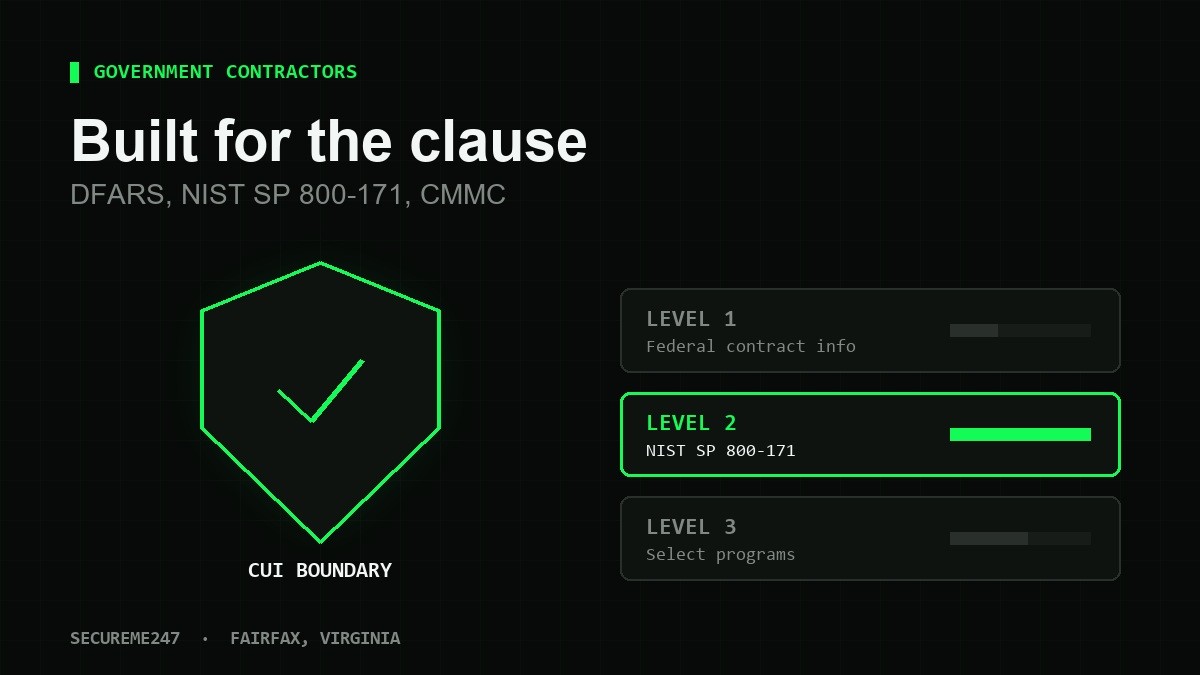
The certification framework that verifies the above. Level 1 covers basic safeguarding of federal contract information. Level 2 aligns with the NIST SP 800-171 controls and is where most contractors handling controlled unclassified information land. Level 3 applies to a much smaller set of programs.
A point of confusion worth clearing up. Service providers are not certified in a way that transfers to you. Your assessment is yours. A provider can build and maintain the environment that passes it, and can produce the evidence, but the obligation does not move off your shoulders.
What Your Provider Should Be Doing Differently
A general IT provider keeps your systems running. A provider working with contractors does that plus a category of work that a commercial office never needs.
Maintaining a system security plan. Not writing one once. Keeping it accurate as the environment changes, because an out of date plan is worse than an honest gap.
Tracking a plan of action and milestones. Open gaps, owners, and target dates. Assessors expect this to exist and to show movement.
Collecting evidence continuously. Screenshots, logs, configuration exports, and access reviews gathered as they happen rather than reconstructed in a panic before an assessment.
Managing the boundary. Knowing exactly which systems touch controlled unclassified information and keeping that boundary small on purpose. Scope creep here is expensive, because every system inside the boundary carries the full control burden.
Handling the seventy two hour reporting path. Knowing who calls whom, what gets preserved, and how the report gets filed, decided in advance rather than during an incident.
The Microsoft 365 Question
This one catches more Fairfax contractors than any other single item, and it is expensive to get wrong.
Commercial Microsoft 365 and the government cloud offerings are different environments with different compliance characteristics. If your contract requires controls that the commercial tenant does not support for your data type, the fix is a tenant migration, which is a project rather than a setting.
The right time to answer this question is before you migrate anything, not after your data has been in the wrong place for two years. If your provider has never raised the question with you and you hold contracts with security clauses, raise it with them.
Where Contractors Usually Fall Short
These are the gaps that come up repeatedly, and none of them are exotic.
No risk assessment, or one done once and never revisited. This is the most commonly cited deficiency across regulated industries generally.
Multifactor authentication deployed partially. Enabled for email but not for remote access or administrative accounts, which leaves the paths that actually matter open.
Unmanaged personal devices touching contract data. A phone with company email counts, and most policies do not address it.
Subcontractors with access nobody tracks. Flow down obligations mean their posture becomes your problem.
Logging that exists but nobody reads. Collecting audit records satisfies nothing if no human reviews them and no retention period is defined.
Documentation written for the assessment rather than for the environment. Assessors notice when a policy describes a company that does not exist.
Evaluating a Provider for Contract Work
Standard questions plus these. The answers will separate providers quickly.
Have you supported a client through a CMMC assessment, and what was the outcome? Which controls do you own and which remain ours, in writing? How do you collect and store evidence, and can we access it independently? What is your process when we receive an incident that triggers the seventy two hour clock? Do you work in government cloud environments or only commercial? What happens to our compliance evidence if we terminate the agreement?
A provider who answers these fluently has done the work before. A provider who says compliance is included but cannot describe the mechanics has not.
Frequently Asked Questions
Does my IT provider need to be CMMC certified?
Not in the way most buyers assume. Certification applies to your organization for your contracts. What matters is whether the provider can build, document, and maintain an environment that meets the control requirements, and produce evidence when you are assessed.
How long does it take to become ready?
For a contractor starting from a typical commercial setup, plan on twelve to eighteen months. Much of that is not technical work. It is documentation and the accumulation of evidence over time, which cannot be compressed at the end.
Can we scope this down?
Yes, and you should. Deliberately limiting which systems handle controlled unclassified information is the single most effective way to reduce cost and effort. This is architecture work worth doing early.
What does compliance support add to the monthly cost?
Typically $30 to $75 per user per month above a standard managed agreement. That buys documentation, evidence collection, and policy maintenance rather than additional help desk hours.
We are a small subcontractor. Does this apply to us?
If controlled unclassified information flows down to you, yes. Size does not exempt you. It only means you have fewer people to absorb the work.
Getting Ahead of It
The contractors who handle this well started before a bid forced them to. The ones who struggle are always trying to reconstruct two years of evidence in six weeks.
SecureMe247 works with government contractors across Fairfax County and the Northern Virginia corridor, including the boundary scoping and evidence collection that assessments depend on. If you want to know where you currently stand against NIST SP 800-171, that assessment is the right first step.
Ready to strengthen your security posture?
Get a free security assessment, no obligation.